RSA 7/10 – Cheetah!

Playout date: 22 November 2006
Duration: 2:55
Camera: Panasonic DMZ -FZ30
Post Production: Windows Movie Maker – slight use
Location: Moyo, Stellenbosch area of South Africa
Other people featured: CHI colleagues
Genre: Environmental
Music used: “This could be heaven” by Queen
Languages used: English
Animals/plants featured: Cheetah (Acinonyx j. jubatus)
Other remarks:

This lovely animal was walked around us before the food was served and we were asked to keep calm. He remained with his handlers at the top stage during117777 the meal, and was continually stroked and petted by these handlers. In addition to seeing the cat, another attraction of the evening was having local tribal markings plainted on our faces using something that looked a bit like Tippex. The scenery from the mountains we saw on the way when visiting the Stellenbosch wine region was also unlike anything I had seen before. South Africa is a wonderful country.

Sealy Phocas (South Africa series 4/10)

Playout date: 14 November 2006
Camera: Fuji Finepix
Post Production: Windows Movie Maker – slight use
Location: Hout Bay, Cape Town
Other people featured: David Uncleborough, Afrikaaner boat captain, Viktor Dmitrievitch Huliganov, Pierre Delauney
Genre: Environmental
Music used:  Heaven for Everyone, Queen
Languages used: English, but with Russian and French words for seal.
Animals featured: Arctocephalus pussilus, Cape fur seal

I rarely do a lot of different voices on one video, but this is one occasion. I do what I hope is a passable
impersonation of David Attenborough (I called this character David Uncleborough and he comes up a couple of times in my films), and also I do a South African, some Huliganov and some Pierre Delauney.
The Hout Bay cape fur seal colony is a beautiful thing to see. This is the part of the world where the great
white shark preys on these creatures, even jumping out of the water to attack them. We didn’t see any of them today, though.
The mountains around are the twelve apostles, very majestic neighbours of the Table Mountain.

Old Usenetposts Gallery #5 Coots in cahoots

Gallery Page 5 – Coots in cahoots


The birds you see here are the common coot, Fulica atra, which is similar to the American coot Fulica americana, only with a ‘balder’ appearance, as the white headshield is higher in the Eurasian version, leading to the expression ‘as bald as a coot’. The term ‘coot’ in itself is in all likelihood onomatopoeic in English, as one common noise the bird makes, among a large playlist of other calls and alarms made by the splashing of its specialised lobed feet, is like the syllable ‘coot’. The only language that shares with Engolish the name ‘coot’ is Dutch, which calls the bird ‘Meerkoet’. The German term is ‘Blaesshuhn’, the Scandywegian languages are ‘blishoene’ and ‘sothoene’, but don’t ask me which is which, the Russian is Lysukha’ and the Polish is ‘Lyska’, and the Romance languages show mainly variants on the latin ‘Fulica’ (Fr. ‘Foulque’, Sp. ‘Focha’ , It. ‘Folaga’)

Coots wintering on the Vistula near Plock – Photo taken at Nowy Duninow, December 2004

These coots are resting together on the retention reservoir which has been made in the Vistula River between Plock and Wloclawek in a ribbon several birds deep and several kilometres long, strongly calling to mind the appearance of the band of rooks in migratory flight over Warsaw each spring and Autumn, only resting on water rather than flying through the air. These birds will migrate in the spring into East Poland, Belarus and Russia for the summer breeding period – this is the most westerly point on mainland Europe that they are found all year. They live for about 18 years, are omnivorous, and considered as a type of rail: family Rallidae, order Gruiformes.

More beautiful landscape scenes from Poland and elsewhere coming up…

DJJ 13th February 2005

Old Usenetposts Gallery #2 Tropical Birds

(I’m continuing with the repost of old material from the former Usenetposts.com)

Gallery Page 2 – Tropical Birds
Right, still with me? Good. We’re still looking at unidentified fauna. Here we have a kind of gull that I’ve never seen in Europe, with a kind of hairstyle, as it were, of an old English teacher of mine. (I use that possessive pronoun attributively, not possessively, as he would say). Provisionally, therefore, I’ve named it the Saunders gull – but what is its real name? E-mail or bulletin board if you know the answer. Seen in the Dominican Republic, Casa de Campo, November 2004.

This seagull is probably not new to science, but it was new to me

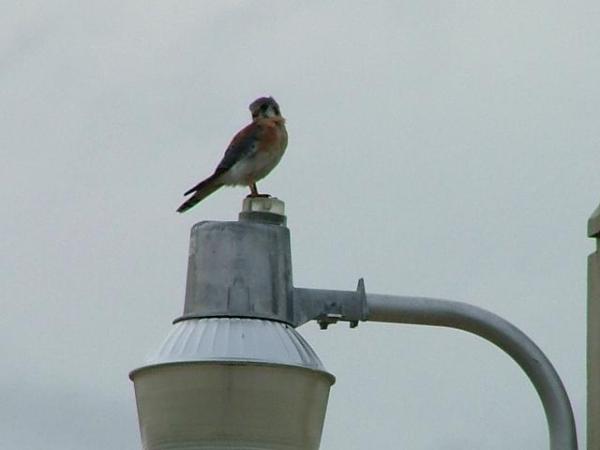
Again from the Dominican Republic in November 2004, is this small reddish hawk. The picture doesn’t deserve its own page, as the quality is not good, but still I don’t know the bird so I’m hoping someone will tell me what it is. This is the best of three I managed to take before it flew away.

The tiniest hawk I ever saw

More animals coming up, before moving on to other themes…

DJJ 13th February 2005

Monty the ginger cat not reacting to Colonel Bogey

Playout date: 7 October 2006
Camera: Fuji Finepix
Post Production: None
Location: Hemel Hempstead
Other people featured: My wife and my dad
Genre: Cat film
Music used: A whistled version of Colonel Bogey (Creative commons)
Languages used: English
Animals featured: Monty the ginger cat

I used to be able to make my old cat come by whistling Colonel Bogey like this, but Monty was a one-man cat, and could only be summoned by my father. He was at first my sister’s cat, but when she started to live with her later husband, the cat needed a new home as like most young people these days he is an allergist for cats.

Unfortunately Monty passed away a couple of years back, having lived about 17 years, which is a ripe old age. His presence lives on a bit in the house in a way. I still go gingerly into the kitchen when the light is out from having needed to do so before in order not to walk into him.